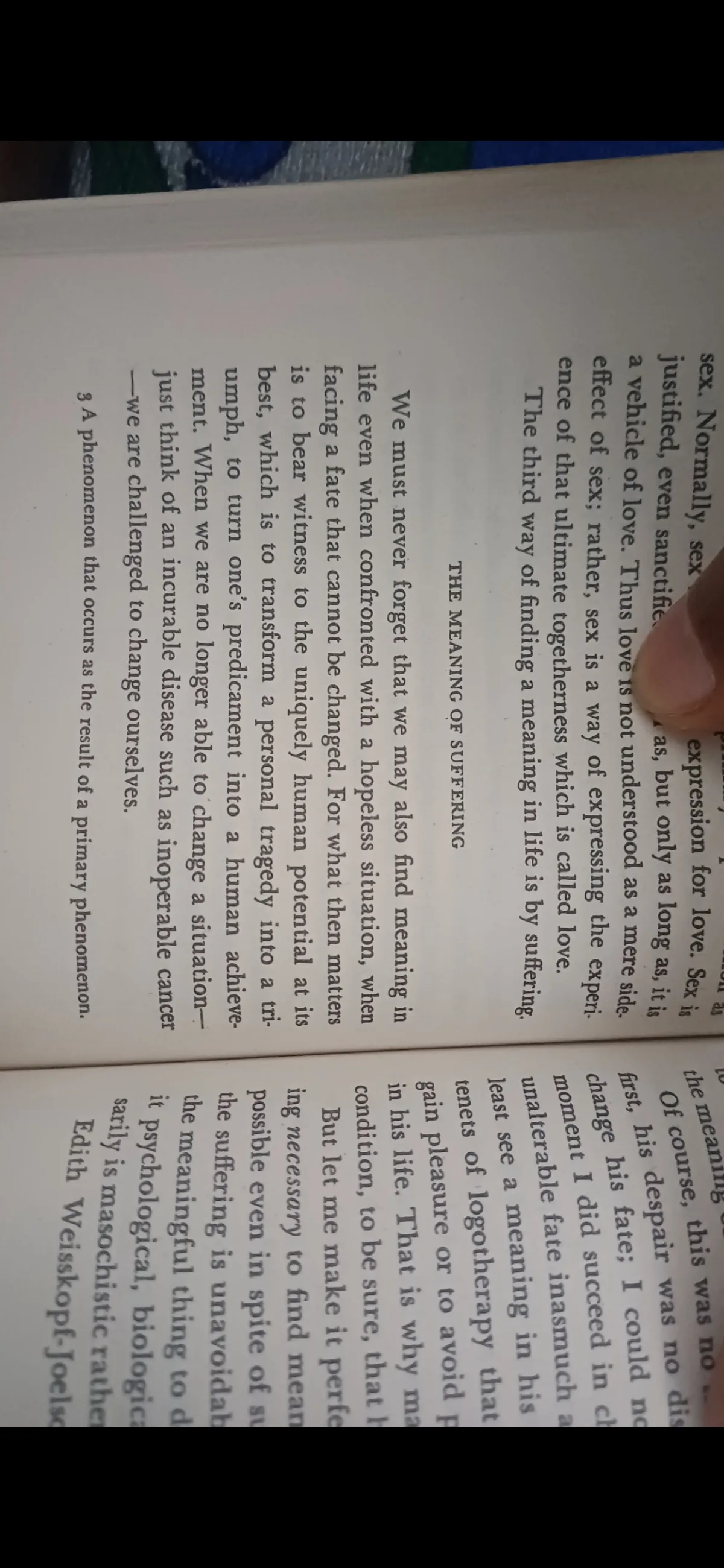
In Man's Search for Meaning, Viktor Frankl describes the meaning of suffering as the ultimate opportunity for human achievement, asserting that while suffering is an unavoidable part of life, it ceases to be suffering the moment it finds a purpose, such as a sacrifice. Drawing from his grueling experiences in Nazi concentration camps, he explains that when an individual is stripped of all external freedom and faced with an unalterable fate, they retain the ultimate human freedom: the ability to choose one's attitude in any given set of circumstances. Frankl argues that suffering acts like a gas, completely filling the human mind regardless of its objective size, meaning that no two struggles can be compared, yet every predicament offers a crucible where a person can rise above their outward fate, mold their pain into a moral victory, and realize the deepest values of human dignity.

Share
Copied